Xenon control modules, relay harnesses, CAN-bus decoders, KL7000 central controllers — the Hella controls stack is what keeps the luminaire legal, diagnostic-clean, and easy to upfit across 12 V and 24 V platforms.
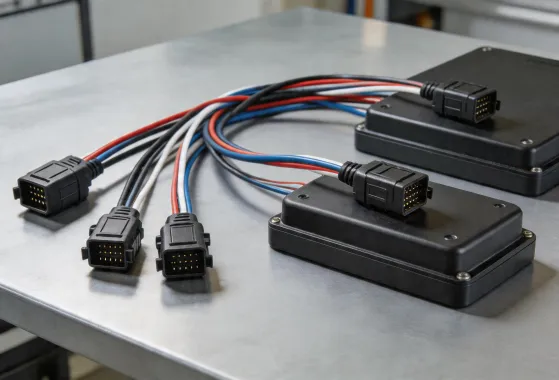
8GS and 8855017 xenon ballasts keep legacy HID headlamps in service without resorting to third-party rebuilds. Each module is matched to the bulb-voltage curve Hella specifies, which is the reason the OE service life rating still applies.
When an LED replacement lamp triggers a "bulb out" warning, a canceller harness rewrites the resistance signature back to what the vehicle expects. Hella ships region-coded cancellers for VW, BMW, Mercedes, and Ford platforms rather than a generic part.
Auxiliary driving lights routed off the high-beam feed need a relay, a fuse of the right A-rating, and wire gauge matched to the total LED draw. Hella publishes complete harness kits so the upfit shop is not sizing wire gauge from memory.
For emergency and service vehicles the KL7000 series is a programmable central controller — flash pattern selection, zone coordination, and audio-alarm integration in a single 12/24 V unit. Configuration uses a Windows tool, not DIP switches.
Driver-facing keypad for operators who need to switch warning patterns, light zones, or aux beams without reaching under the dashboard. Paired with the KL7000 over a 4-wire bus.
For vehicles added to post-2011 European fleets where DRL is mandatory, the Hella LEDayLine and LEDayFlex modules supply the ECE R87-compliant running light circuit separately from the main headlamp.
| Scenario | Recommended Controls | Typical Part Family |
|---|---|---|
| Retaining legacy xenon headlamps beyond year 10 | Replace failing ballast with OE-spec Hella module; keep original bulb series. | 8GS / 8855017 xenon control modules |
| LED H4 retrofit on CAN-bus vehicle | LED canceller harness sized to vehicle CAN signature. | Hella LED canceller family |
| Four-light driving-beam upfit on truck | 70 A relay kit with high-beam trigger and fused power feed. | Driving light harness kits |
| Emergency vehicle, multi-zone warning system | KL7000 central controller paired with RTK7 keypad and audio alarm. | KL7000 series |
Three recurring debates shape almost every controls specification. Neither side is universally right; the answer depends on platform age, retrofit window, and serviceability preference.
Choose wired when the platform is a CAN-bus vehicle already carrying a harness: deterministic timing, no battery maintenance, and cleaner enterprise diagnostics.
Choose wireless when the retrofit window is measured in hours per vehicle: conduit work drops, phased rollouts accelerate, and mixed-age fleets can be brought online without tearing out cab trim.
Integrated (luminaire + driver + controller from one vendor) reduces compatibility testing and keeps warranty ownership with a single party.
Modular (fixture, driver, and controller chosen separately) improves long-run swappability — a dead KL7000 zone card can be replaced without touching the lamp, and LED engines can be upgraded mid-life.
Prioritize efficacy for long-haul auxiliary lights where run-hours dominate energy cost and a rebate window is open.
Prioritize comfort in cab-mounted and work-area applications: lower glare, tighter cutoff, and controlled beam spread reduce operator fatigue even when lm/W is a few points lower.
Known limitations to disclose up front: 1) Wireless commissioning tools require Windows-only configuration utilities today; 2) LED cancellers are vehicle-family specific — a VW canceller will not suppress a Ford CAN fault; 3) L70 rating assumes ambient below 60° C — engine-bay installs above that temperature shorten service life.
The other half is the module or harness that makes it behave on the vehicle. Send the platform list and the lighting intent — the Controls Hub team will reply with the matching module, harness, and wiring diagram.