Hella has been building automotive lighting and electronics since 1899. The fleet and aftermarket programs represented on this site carry the same Tier-1 discipline that goes into OE headlamp modules — photometric verification, harsh-environment testing, and long-tail aftermarket continuity.
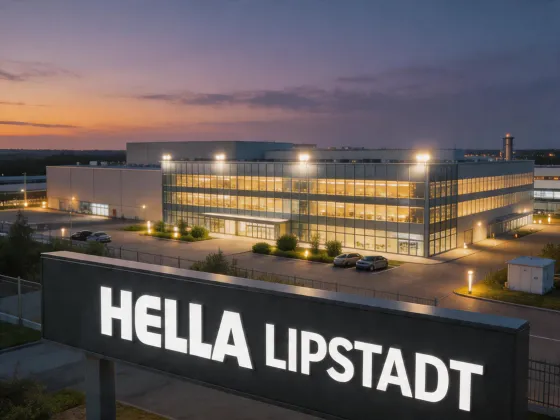
Our Lippstadt plant still carries the original Hueck family legacy. Today the fleet program is supported out of Peachtree City, Georgia for North America and regional hubs in Europe, South America, and Asia-Pacific.
A driving light is rated by what the beam actually does at 75 meters, not by the lumen figure on the outer carton. Every Hella auxiliary SKU has a published IES file; the fleet desk uses it before any part number is released.
ECE, SAE, DLC, RoHS, REACH — compliance is owned by engineering, not a separate regulatory team. That is why the approval number is printed on the lens, not filed away in a PDF an aftermarket importer has to re-chase.
Some of the most-sold Hella auxiliary lights have carried the same bolt pattern and lens diameter since the 1980s. The internals were modernized to LED; the bracket stock on a fleet's shelf still fits.
Salomon Hueck established the company that would become Westfalische Metall-Industrie and later Hella.
Acetylene headlamp production marked the pivot into automotive lighting that still defines the company.
Hella delivered the first production HID headlamp for BMW, setting the standard for high-performance optics.
LuminatorLED and Black Magic ranges brought the OE LED engine family to the aftermarket and fleet channel.
UL 1598
DLC Premium
CE / ECE
RoHS
ISO 9001
If the lighting spec on your fleet is still a carton of mixed part numbers, the Hella desk is ready to rebuild it. Photometric data, homologation files, and aftermarket continuity are all part of the first conversation.